
El Campesino
The General Who Fought Franco and Stalin

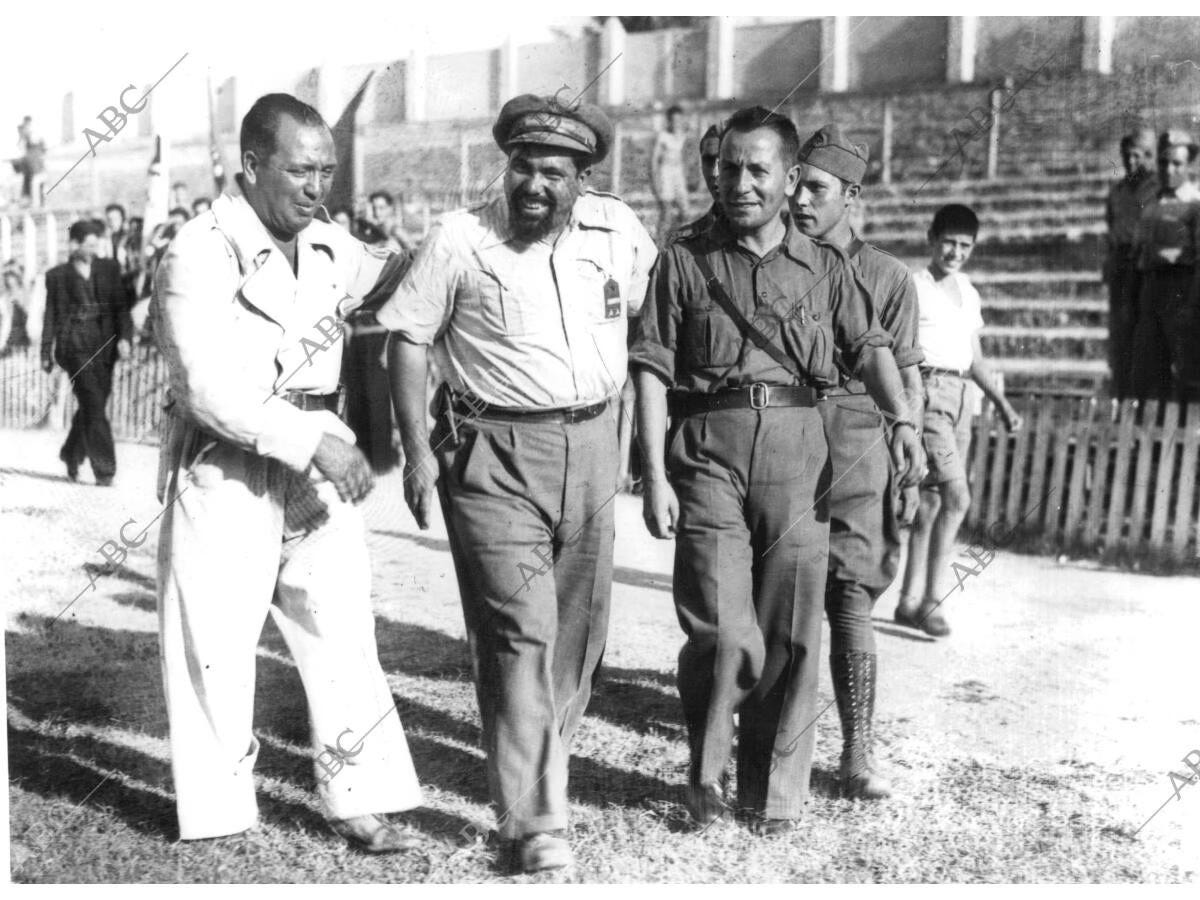
He stepped down from the train in Moscow in the winter of 1939. He was frostbitten and famished but still carried himself with the confidence of a man accustomed to command.
The Soviet official noted his profession on the entry papers: campesino, peasant – unaware that the term had once rumbled like artillery across the valleys of Aragón. Behind lay the smouldering ruins of the Spanish Republic, the thousands of dead whose ghosts travelled with him across the Urals. Ahead waited the vastness of Stalin’s Russia.
To the world, Valentín González was El Campesino – a nom de guerre worn like a crown wrested from the earth itself. Born in 1904 in Malcocinado, Extremadura, among stone, scrubland and the extremes of heat and poverty, he was one of nine children who learned early that the first lesson of hunger and hardship is that the world deals its cards marked. The second is that a strong arm may reshuffle the deck.
At fifteen he went down the mines at Peñarroya. There among dynamite fumes and the bitter union struggles of Spain’s coal belt, the legend began: the boy with the fists of a mule driver and the tongue of a street preacher – the pitman who could strip a bolt-action Mauser blindfold.
His activism grew into militancy after the fall of Primo de Rivera’s dictatorship (1923-1930). Following King Alfonso XIII’s deposition, Spain’s Second Republic, proclaimed on 14 April 1931, came to power by popular vote and immediate unrest on the Right – the landowners, the Church, the military, the quasi-fascist Falange with their Nazi salutes, blue shirts and red berets. The strike that led to a revolution in Asturias in 1934 was brutally suppressed by the Army of Africa drafted in from Morocco by the rising young General Francisco Franco. Some 1,700 Spaniards were killed on Spanish soil by colonial forces. The massacre tempered González like steel in a smithy.
When the generals rose against the Republic in 1936, he did not hesitate. Spain had become the Rorschach test of the century: to some a crusade, to others a revolution. González fought for the poor because they were his, because injustice was a personal wound, and because war, like the mines, is a place where strong men rise.
On the Madrid Front, amidst rubble and martyrdom, El Campesino made his name. The soldiers of his 46th Division spoke of him with mingled awe and dread. He drilled poorly armed recruits like a sergeant major with a debt to settle. He shot deserters himself rather than waste ammunition on firing squads. His bravery was inspiring. He strode along trench lines in view of Moorish snipers, shouting insults about their mothers in Arabic learned God-knows-where. Once, in the Casa de Campo, he climbed from the parapet to direct an assault with hand signals – and lived. A soldier remarked later: ‘Bullets are afraid of him. We are terrified.’
The Communist Party newspapers spread his renown through the power of the heroic photograph. El Campesino looked the part: stocky, black-browed, with a miner’s neck and a Hussar’s moustache. The peasant general – barefoot democracy made real – whose illiteracy seemed a virtue and whose rage spoke the language of the plough and the barricade.
But behind the propaganda lurked friction sharp enough to draw blood. The disciplined cadres trained in Moscow – Enrique Líster, Juan Guilloto León, known as Modesto, and the Yugoslav Vladimir ‘Senjko’ Ćopić – viewed him as a magnificent savage: necessary for morale, dangerous for command. He was too independent for Stalin’s liking and too vainglorious for the Republican cabinet.
In Teruel, his division fought with the ferocity of men born to hardship, yet arguments with commanders and accusations of insubordination tarnished the victory. When Nationalist counterattacks broke the Republican lines in Aragón, El Campesino blamed treachery, sabotage, anything except the grim mathematics of war. He shouted these accusations loudly – into radios, at party meetings, in bars – and such men seldom retire peacefully from the fray.
By 1938, the Republic was dying like an animal trapped in brambles, while the world looked on from the café terraces of Paris and the polished streets of Whitehall. The International Brigades marched away with tears and fists raised, and the Army of the Ebro – including El Campesino’s troops – crossed the river for the last doomed gamble, a bold gesture of courage against logistics. González fought stubbornly, obstinately, brilliantly – but history attends to factory output, not to heroism. When Barcelona fell, he led a column of refugees toward the Pyrenees, haggard and starving, the Republican tricolour rolled under his coat.
Exile in France proved no refuge. Internment followed, then escape. For a devout if unruly Communist, the road to redemption lay east, toward the promised land of equality. In 1939, disguised, he crossed into the Soviet Union, cradle of the revolution he believed he had served faithfully. But Stalin’s Russia was engaged in an alchemy unknown to the dialecticians of Madrid: from every man a confession; to every heresy a bullet.
In Moscow, among comrades whose portraits had hung in Republican canteens, El Campesino waited for deployment. Instead came suspicion. The secret police, the NKVD, interrogated him about disagreements with Soviet advisors in Spain that had existed chiefly in rumours and jealous bulletins. In April 1941, he was arrested on charges that were vague, bureaucratic and lethal. He was labelled a ‘Francoist spy,’ an accusation so absurd - in that Orwellian way - it became plausible. Reason, too, had been collectivised. Gide and Orwell were right. Stalin had not liberated and promoted the working classes, he had betrayed them.
Then began the odyssey: Butyrka Prison, the long train eastward, the Arctic camps where the night lasts months and men last less. The former general cut timber, hauled rocks, survived on black bread and the memory of applause. He witnessed men of iron wither into bones. He refused to die. Survival became an act of defiance more potent than any speech in the Cortes.
War World II ended. Stalin died. The machinery of terror paused long enough to reassess its files. In 1954, El Campesino was released, not to return a hero, but to a small apartment and a job as mechanic’s assistant. The man who had commanded thousands now queued for cabbage. His faith had been amputated. He later told his biographer: ‘I went to Russia a Communist. I left a corpse, mistaken for a man.’ Eventually, through audacity worthy of fiction, he escaped across the Iranian border and sought asylum. The Cold War press made him exotic – the Spanish general who survived both Franco and Stalin – but exile is a country without maps.
He lived quietly thereafter. Some said he went to Mexica. Others to Miami. There were rumours of plots and memoirs. The legend frayed like the well-worn flag of the Republic he still carried. He published a book damning the Soviet Union, which the Right applauded cautiously and the Left dutifully condemned. Franco’s Spain dismissed him as a criminal. Moscow called him a liar. The Spanish Communist Party scrubbed his name from its histories.
Yet memory is a stubborn archivist. For those who fought in the olive groves and mountains of Spain, El Campesino remains the man who embodied both the splendour and futility of the Spanish Civil War, courage tied to chaos, idealism strapped like dynamite to a fractured nation. His was a destiny of extremes, drawn from a century intoxicated by them. He served no master faithfully – not Stalin, not even the Party whose flag he carried. He served, perhaps unknowingly, the raw instinct of resistance: the refusal to bow.
History prefers its heroes tidy and its villains labelled. El Campesino is neither. He was a brute and a banner, a commander who inspired and terrorised in equal measure, a revolutionary who learned too late that the revolution devours its own. He once said, with the bleak humour of miners and soldiers: ‘War is simple: you kill, or you lose.’ He lost – territory, comrades, homeland, illusions. But he did not surrender.
The peasants of Malcocinado no longer remember the boy who went to the mines. Madrid has paved over its barricades. The Soviet Union is an entry in the atlas of vanished empires. Yet somewhere along the banks of the Ebro, in the silence between cicadas, one might imagine the ghost of a stocky figure, coat buttoned against a wind, shouting orders into the river fog.
Long before prisons and betrayals, he once declared, ‘The land belongs to those who work it.’ In another century, under gentler skies, he might have remained simply that: a farmer, a miner, a man among men. But Spain in 1936 was no place for quiet destinies. It demanded myth, sacrifice, theatre, catastrophe. Valentín González, El Campesino, gave it all. And in his ruin, he offers a final, unwelcome gift: a caution whispered from the ditch beside history’s road – that the revolution, and the counter-revolution, require payment in lives and dreams, that justice pursued with bullets loses its way, that the people’s general may become the state’s prisoner, and that men of the soil, raised to command by necessity and fire, are often the first to be ploughed under.